Best 3D Printer for Carbon Fiber: What Home Printers Need Before You Buy
Carbon-fiber-filled filament can make stiff functional parts, but it wears ordinary brass nozzles. Start with a compatible enclosed printer and nozzle.
By Harper Lin
3Dprintpicks is reader-supported. As an Amazon Associate we earn from qualifying purchases. Learn more.
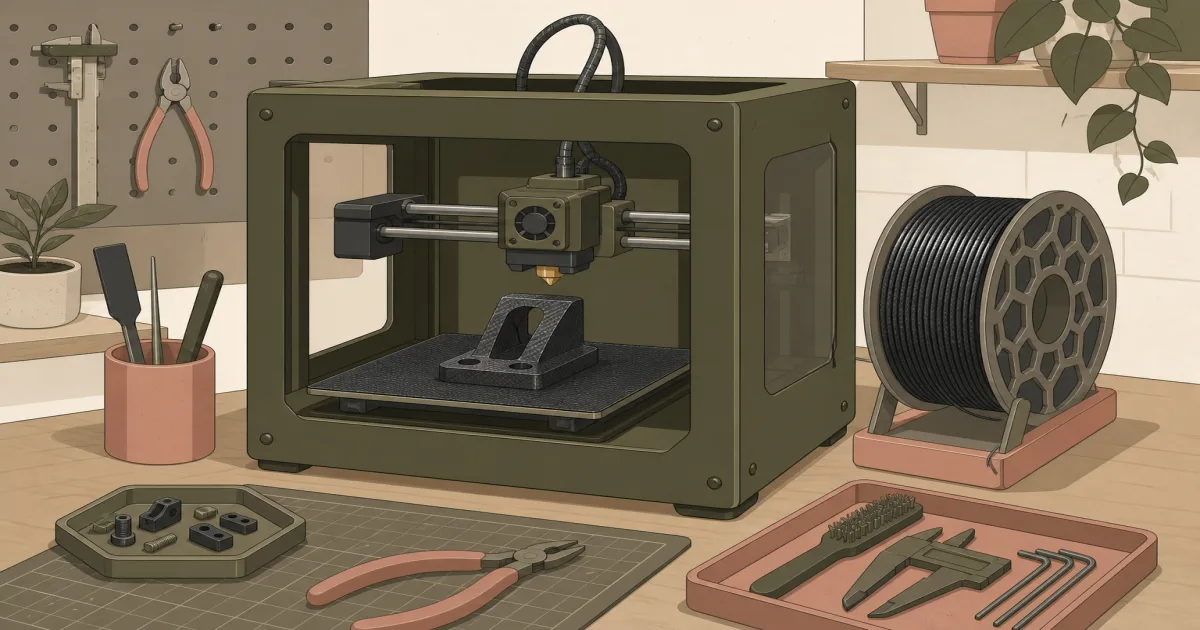
The short answer: The Bambu Lab P1S Combo is a capable home-platform starting point for carbon-fiber-filled filament, but the important purchase is the correct hardened nozzle and material profile. Do not send abrasive filament through a stock brass nozzle and hope for the best.
Our picks
Carbon-fiber-filled filament is appealing because it can make stiff, clean-looking functional parts. The catch is simple: chopped fiber is abrasive. It can turn a soft brass nozzle into a wider, uneven hole faster than ordinary PLA. That changes extrusion and makes print quality harder to diagnose.
This pick is research-based from a live US Amazon listing, published product information, and owner review evidence. The listing was live and above the four-star rating floor when checked. Before you buy, confirm the exact current nozzle, hotend, and filament compatibility for the printer configuration you select.
The nozzle is the first compatibility check
Use a hardened nozzle for carbon-fiber-filled materials. Brass is ideal for ordinary PLA because it heats evenly and is inexpensive, but it is not built for abrasive fibers. A hardened nozzle lasts longer and keeps its opening more consistent.
Our 3D printer nozzles guide explains the practical brass-versus-hardened-steel choice. It is worth reading before buying a spool. The wrong nozzle can make an otherwise good printer look like it has a slicing problem.
Some filled filaments also prefer a larger nozzle to reduce clog risk. Follow the filament maker’s guidance rather than assuming every 0.4 mm setup will behave the same. Make a small test part first, then check the nozzle and first layer before starting a long bracket or fixture.
Why the P1S is a sensible home base
The Bambu Lab P1S Combo gives home users an enclosed printer platform that is easier to place and operate than a heavily modified open-frame machine. That does not mean it is automatically configured for every carbon-filled polymer. Treat the printer, nozzle, and material as a matched set.
Enclosure needs depend on the base plastic. Carbon-fiber PLA is different from carbon-fiber nylon or ABS. The latter materials can ask more of room temperature, drying, and ventilation. If you are shopping primarily for a contained machine, compare options in our best enclosed 3D printer guide.
Keep the first spool simple
Start with a small useful part such as a bracket, tool holder, or stiff spacer. Do not make your first filled-material job a twenty-hour frame component. Dry the filament as its maker recommends, load the intended material profile, and watch the first layer.
Carbon fiber is not a shortcut around bad design. Print orientation, wall count, and load direction still determine whether a part survives. Use it when stiffness and finish solve a real problem, not because the spool sounds more advanced.
Keep wear and safety in view
Inspect the nozzle after the first few filled-filament jobs and replace it when wear changes the print. Use the filament maker’s temperature and drying guidance, because carbon fiber does not cancel out the needs of the base plastic. Keep the printer area clean too. Abrasive materials are a reason to be more deliberate, not a reason to leave the machine alone while you learn a new profile.
If you only need an ordinary indoor bracket, regular PLA or PETG may be cheaper, easier, and completely adequate. Carbon fiber makes the most sense when you have a specific stiffness or finish reason for choosing it.
Bottom line
The best 3D printer for carbon fiber is one with a compatible hardened nozzle, a clear material path, and settings you can verify. The Bambu Lab P1S Combo is a practical home starting point once you match it with the correct wear-resistant nozzle and the filament maker’s guidance.
Frequently Asked Questions
Can any 3D printer use carbon fiber filament?
No. Carbon-filled materials can wear a brass nozzle quickly, so confirm nozzle and extruder compatibility first.
Do I need a hardened nozzle for carbon fiber PLA?
Yes, a hardened nozzle is the usual starting point because the fibers are abrasive.
Is carbon fiber filament stronger than every other filament?
Not automatically. It can improve stiffness, but material choice depends on the part and print direction.
Can beginners print carbon fiber filament?
They can, but learn the printer with PLA first and make the nozzle change deliberately.
Does carbon fiber filament need an enclosure?
It depends on the base polymer. An enclosure is more important for some engineering blends than for carbon-fiber PLA.
What nozzle size should I use?
Check the filament maker’s guidance. Many filled filaments work more reliably through a larger wear-resistant nozzle.