PVA Filament: Water-Soluble Supports Without Ruining the Model
PVA filament dissolves support structures in water so complex PLA models keep clean faces. Buy a sealed spool, keep it dry, and pair it with a dryer if your room is humid.
By Nate Brooks
3Dprintpicks is reader-supported. As an Amazon Associate we earn from qualifying purchases. Learn more.
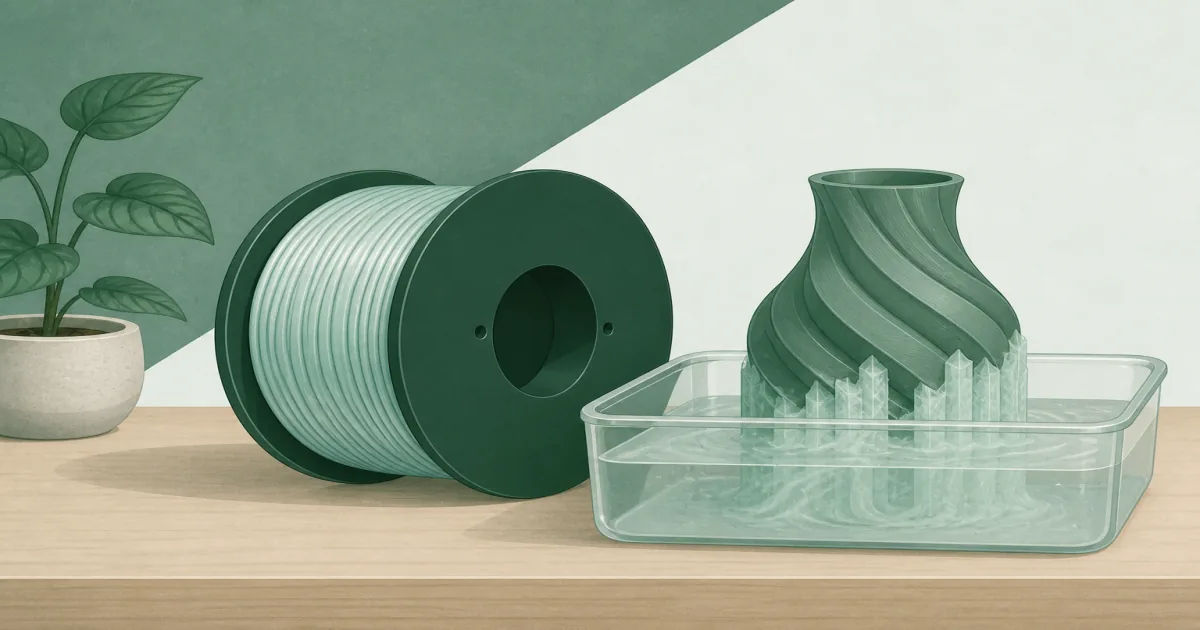
The short answer: Buy Fused Materials PVA Filament when you have a dual-extrusion path and models with trapped supports. Add the SUNLU S1 Plus dryer in the same order if your room is humid, because wet PVA fails before the model ever reaches the water bath.
Our picks
PVA filament is support plastic that dissolves in water. The point is geometry you cannot reach with a flush cutter: internal channels, interlocking parts, and deep cavities where breakaway supports would scar the face. It is not a everyday building material.
You need a printer path that can load two materials, and you need dry PVA. If you are still choosing a first multicolor or dual-material system, read best multicolor 3D printer. For ordinary single-material filament buying, stay on best 3D printer filament.
What PVA is for (and what it is not)
Use PVA when the support interface would ruin a visible face, or when supports sit inside a sealed volume. Do not use it as a cheap “stronger PLA.” It is soft, thirsty, and expensive for the amount of plastic you actually dissolve away.
Plan purge and interface settings before the overnight print. A beautiful model with a fused PVA blob in the nozzle is still a failed job.
Kit item 1: Fused Materials PVA
Fused Materials PVA Filament is the support spool for this kit. It is aimed at dual-extrusion wash-away work with PLA-class model materials. Buyers who leave the bag open learn the hard lesson: PVA that drank overnight prints like chewing gum.
Keep the vacuum bag and desiccant. Reseal after every session. If the filament feels soft or sticky, dry it before you blame the hotend.
Kit item 2: SUNLU S1 Plus dryer
SUNLU Official Filament Dryer S1 Plus is the second half of the kit for humid rooms. PVA wants a dry box more than PLA does. Feeding through a heated dryer while the support runs is the boring habit that keeps soluble jobs alive.
If you already own a dual dryer or a sealed dry cabinet, you can skip the second buy. If your PLA already strings after two open days, do not start PVA without a dryer plan. See filament dryer and filament storage for the wider humidity stack.
How to run a PVA support job without drama
Print the model material first in your mind: temperatures, bed adhesion, and whether the interface will bond. Then set PVA cooler and slower than your ego wants. Purge enough between swaps. After the print, soak the part and wait. Warm water and gentle movement beat chisels.
Clean the nozzle after PVA sessions. Leftover PVA left cooking in a hotend is how people invent “mystery clogs.”
Interface and purge habits that save parts
Give the slicer an honest purge volume. Starving the purge looks thrifty until the first PLA layer inherits a gummy PVA smear. Keep interface spacing tight enough for a clean face, but not so tight that the model plastic welds into the support forever.
If your AMS or dual path keeps misfeding, dry both spools before you rewrite the whole filament map. Wet PVA binds and bucks. Wet PLA strings into the mess and makes the failure look like a hardware problem.
Store PVA like a humidity sensor with a price tag. Clip the end, reseal the bag, and park the dryer nearby. People who treat PVA like a decorative open-shelf color usually quit after one clog.
Projects that earn PVA (and ones that do not)
Earn it for interlocking mechanisms printed in place, deep internal channels, miniature cavities, and architectural models with undercuts you cannot reach. Skip it for simple overhangs a tree support already handles. Skip it for huge purge-heavy rainbow experiments where you are still learning color swaps.
If you only want multicolor PLA signs, you do not need PVA. Buy color first from the best multicolor 3D printer path and keep supports normal.
Common PVA mistakes
Buying PVA for a single-extruder machine “just in case.” Leaving the bag open on a humid bench. Dissolving in a tiny cup that cannot cover the part. Scraping half-dissolved supports with a metal knife and scarring the model. Running PVA, then immediately printing PETG without a thorough purge and wondering why the next week smells weird and prints fail.
Another mistake is expecting cold tap water to erase a dense lattice in twenty minutes. Dense supports take time. Plan the soak while you start the next print.
Buying checklist
Confirm 1.75 mm unless your machine needs another diameter. Confirm you have a dual-material path that can actually load PVA beside PLA. Confirm you have a vessel big enough for the part. Confirm you will dry the spool. Confirm the geometry truly needs soluble supports, not just nicer photos of a support tower.
Browse more setup guides on the blog or start from the homepage if you are still assembling the humidity kit around the printer.
When to skip PVA
Skip PVA on a single-extruder PLA-only machine. Skip it if breakaway supports already leave a clean enough face. Skip it if you will not dry the spool. Skip it for huge purge-heavy color experiments where you are still learning AMS basics.
Bottom line
PVA filament earns its keep on trapped geometry. Start with Fused Materials PVA Filament, keep it sealed, and pair it with the SUNLU S1 Plus when humidity is part of your room. Dissolve the supports in water. Do not invent a weekend of scraping.
Frequently Asked Questions
What is PVA filament used for?
Water-soluble supports. You print the model in PLA (or another compatible plastic) and the supports in PVA, then dissolve the supports in water.
Do I need a dual extruder for PVA?
Yes for true soluble supports. A single nozzle can print PVA alone, but the useful support workflow needs two materials in one job.
Is PVA filament hard to store?
Yes. It drinks humidity. Keep it sealed, and dry it before long jobs if the bag has been open.
Can PVA support ABS or nylon?
Some workflows do, but PLA is the calm starting lane. Match temperatures and adhesion carefully before you invent a hybrid stack.
How long does PVA take to dissolve?
Hours, not minutes, for dense supports. Warm water helps. Agitation helps. Patience helps more than scraping.
Why does my PVA clog the nozzle?
Moisture and heat soak. Dry the spool, purge thoroughly, and do not leave PVA sitting hot in the hotend between jobs.
Is breakaway support the same as PVA?
No. Breakaway supports snap off dry. PVA washes away. Different tool for different geometry.